During my preparation for the Camino, and later on the path, I was given three pieces of advice that served me well. Sometimes advice goes “in one ear and out the other,” but these words of wisdom, from three friends, made for a more successful journey.

Last February, when I was buying gear and going to Hunter Street Park on a regular basis, Debra, a friend since my days of working as a school nurse, came to mind. She’s an avid hiker and has years of experience doing long-distance treks in national parks and other locations. I met with her and showed her my itinerary, asking her to help me gauge how much I needed to walk over the months before I stepped onto the Camino. We worked out my schedule of increasing distance and then we discussed the impact of being on your feet for long hours for fourteen consecutive days.
“You need to have two pairs of trail running shoes that are the same,” she told me. “Switch them out as you train and they’ll be broken in for the trip. One pair won’t last.”
I followed her advice and purchased a second pair. When I was on the Camino, it was great to rest the shoes every other day, giving them a chance to air out and a break from the hard surfaces of cobblestone and rock. It was a practical tip from a very experienced hiker. It reminded me that there are other times in life when I should slow down and ask someone for advice; sometimes I strike out on my own thinking I know more than I actually know 🙂
In the month before I left, I talked with my friend, Mary Pat who’d just returned with her husband from Portugal. He gave me some IT information about purchasing cell phone access, a Sim card that would work well in Portugal and Spain. In retrospect, I’m not sure I heard all of his recommendation; I’ll tell you the rest of that story at another time. But Mary Pat offered a different kind of advice, a way of approaching the enormity of walking 158 miles for the first time.
“Connie, remember, You’re not a twenty-something. You don’t have to keep up with anybody,” she said, then added. “If you’re too tired to get to the next town, call a lift. You don’t have to prove anything, and none of us back here will know the difference.”
I heard her, but knew that I really wanted to walk every step of that Portuguese path. In the mornings, when I left my lodging, I’d see lots of twenty-somethings pouring out of the hostels, mostly walking in groups, some in pairs. Since it was August, they were likely college-age and still on summer break. They walked by me, laughing and talking in their group, many looking down at their phones that appeared attached to their palms, a 2024 appendage for those “young people.”
On Day 9 of walking, I had to cover 16 miles and the end point was Vigo, a big port city. Mary, my trip organizer, advised to be aware of the Camino markers in the city “because it is hard to find the signs.” The following morning, I’d have to navigate through the city, then the suburbs, to a ridge where I’d enter the forest. She’d said, “be ready for some hills as you walk out of town.” That night in Vigo, I felt overwhelmed by tiredness, and worried about getting back on the trail the next morning. It was a busy city and the path to get out and into the quiet of the forest seemed daunting. I prayed about what to do while I rested in my room, building up the energy to go out and find something for dinner.
Ask for help, came to me and I went down to the lobby of the hotel and spoke to the desk clerk. I explained that I was a pilgrim and needed to get help with how to get back on the Camino and navigate the city. The young man pulled out a map, an actual paper map, and pointed to our location.
“You’d go from here, take this street, make a right . . .” and then with his finger he traced the map to the point where I’d be through the suburbs and near the forest.
“But honestly, if it were me,” he said, “I’d take a taxi to that point. You’d avoid all the congestion of the city and pick up the path easily.”
“That sounds good,” I said, and thought of Mary Pat’s words.
“I’ll call and schedule one for you,” he offered.
After that, I was able to relax and enjoy my hamburger at the hotel cafe on the 7th floor terrace, looking out over the water as the sun went down. I slept well, no longer worried about getting through the city. The female taxi driver had long gray hair and was very friendly, knowing exactly where to take me, even telling me she lived in those suburbs near my drop off point.
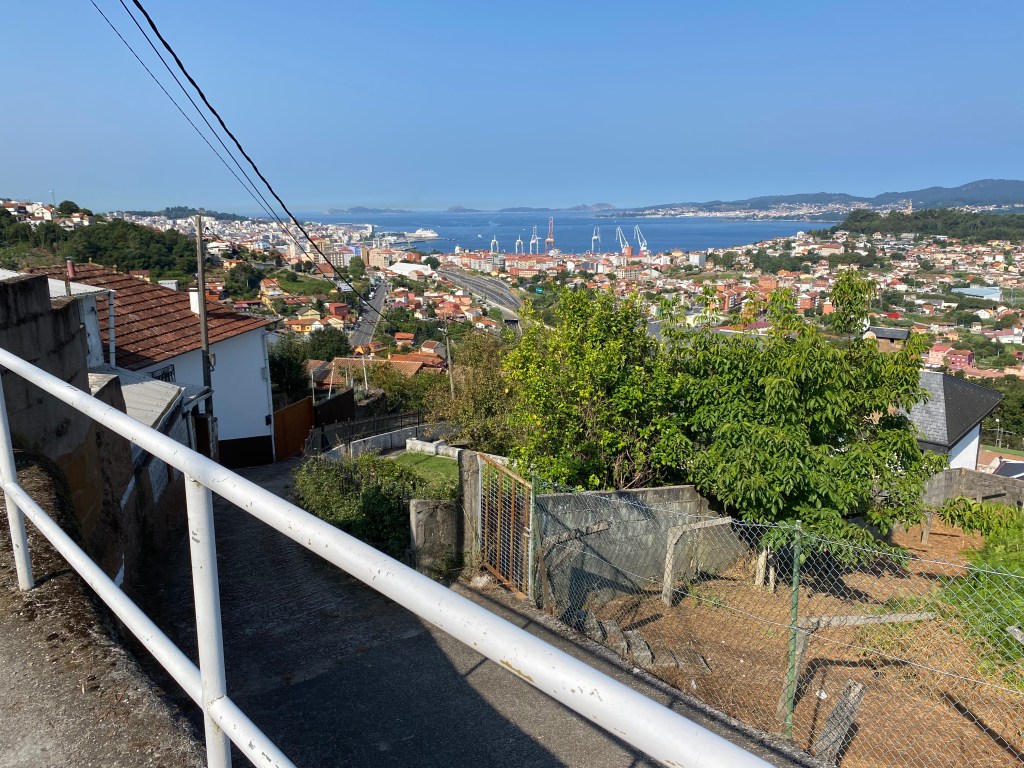
I felt refreshed as I stepped onto the trail, and amazed when I looked back at Vigo in the distance, grateful I hadn’t had to walk those miles through the city.

The final piece of advice, came from a new friend I made on the trail. She was one of two women I met from Germany. Her English was great, and she had no problem with mine because she’d worked for Texas Instrument and spent a lot of time in Dallas. We first met at a pop-up vendor in a forested area of the trail and sat drinking water and eating snacks. We talked about our experiences on the Camino, the areas that had been most difficult. I told her about my experience in Vigo, and must have sounded a bit defensive, when I told her about taking the taxi.
She listened attentively and then said, “That’s fine. You do the Camino Your Way.”

It was nice hearing that permission, though I really didn’t need it, from a young woman, likely a thirty-something. She was very physically fit, participated in cycling competitions. We had several more encounters on the trail, sharing coffee breaks, eating breakfast together on our final day before walking to Santiago. “You do the Camino Your Way” stayed in my head. I thought of it later when I saw two people walking the path with their dogs.

I’m grateful for the advice that served me so well from these three women. It’s not just good for the Camino, but like most experiences on that Pilgrim path, it applies to all of life, that journey that we’re on together.
There are pieces of very practical advice that can save time and energy, like getting two pairs of shoes instead of assuming that’s extravagant–if you’re the frugal sort. There are times when you need to let go of your pride, and not compete with others, and accept changes that come with aging. And no matter your age or situation, it’s great advice to Make this Life Journey Your Own. Only you know what’s best for you.
And with all of this, I wish you the best for using what’s graciously offered to you to make your journey easier.
Best to you,
Connie
“


Love these insights, Connie! Thank you for sharing. I shared your post with my sister who hiked Cinque Terre a few years ago.
Hugs, Kalyani
LikeLike
Hey Kalyani,
So nice to hear from you. We had our writers’ group on Zoom last night. Not as good as getting together in person, but still nice to be with fellow writers. Still miss you being in group and your lovely stories.
Thanks for sharing my post with your sister. Wishing you the best with writing and all that’s going on in your life.
Hugs to you, too!
Connie
LikeLike