Over the past few years, I’ve become a fan of watching Youtube videos by relationship coaches, motivational speakers, and spiritual/faith leaders. Last week, I listened to one by Dr. Wayne Dyer (5/10/40 – 8/29/15), “Everything Happens for a Reason.” Dr. Dyer was a self-help author and a motivational speaker with degrees in psychology and counseling. Years ago, I discovered him “by chance” when I was flipping through television channels on a lazy Saturday afternoon. He was on a PBS show that piqued my interest and afterwards led me to buy one of his CDs in the sale bin at Barnes & Noble.

Years later, I used the conference room landline phone in my husband’s office to listen to a Wisdom of the Whole coaching class. I was allowed to sit in as I was considering whether to take the eleven-month course. As I listened, I noticed Dyer’s book Your Sacred Self on the bookcase in front of me. Afterwards, I borrowed the book and in reading the first chapter I had a ‘knowing’ that I should take the course.
When I saw his video as one of the Youtube offerings, I was reminded of how he’d been a guide for me over the years. His own childhood had begun in a Protestant church and over time had explored broader applications of faith and spiritual principles. For me, none of how his faith broadened had changed his long-held belief in God.
In the beginning of the video, he states that “everything that comes into your life is supposed to and every condition of your life is part of life’s perfection.” There have certainly been times when I’ve wrestled with this idea.
The next belief resonated with me:
“Everybody that you meet, you meet for a reason.”

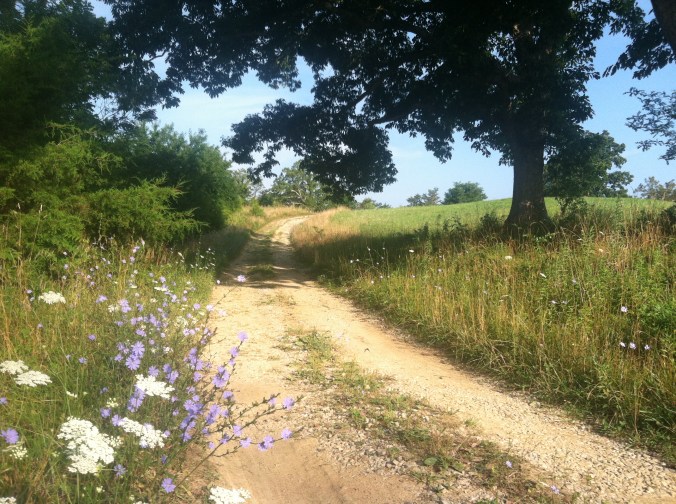
I immediately thought of my Solo Journeys and how I start each day with the prayer, “God bless me and the people in my path.” Through the years, I’ve met people who inspired me, and who’ve helped me with practical problems — like loaning me a tent and giving me directions. Many have told stories about their lives in the towns where I was visiting, like the man I met on Chincoteague Island. He’d known the brother and sister featured in the book, Misty of Chincoteague, and recalled getting out of school for the filming of the movie.
Dr. Dyer goes on to say, “And if you see everybody as a teacher, then you ask yourself, “What do I have to learn here?” He gives the example of the slow driver in front of you may be there to help you to slow down, to not be so hurried in your life. I think of the people in my life and how I can benefit from seeing them as teachers. In that role, our differences become more than that; they have depth. What if I thought of my two sisters as being teachers versus falling back on their family roles as “Big sister who’s like this . . .” and “Little sister who’s like this . . .” ? Instead, I would say of my older sibling, “What does Harriet have to teach me?” and of my younger sibling, “What does Peggy have to teach me?” I don’t think I’ve ever considered them in this way. 🙂
When I think of people whom I’ve been in close connection with over time — like my sisters, other family members, and long-held friends, I see the goal of looking to them as teachers as benevolent.
But what about the people in my life, now or in the past, who’ve caused me pain?
That’s where thinking of them as teachers is more difficult. And remembering that they came into my life for a reason adds more impact.
This week, I met with a friend and fellow writer, Marilyn. I’d read her memoir and she’d read mine. It was so nice to discuss the process of writing our memoirs and the grueling steps toward publishing that followed.

Marilyn brought up the crisis of me being fired from the pharmaceutical research company.
“It must have been so hard to write about that,” she said.
It had been a while since I’d thought about that awful moment when my nemesis at The Research Company, Tara, told me it would be my last day.
“I left it out when I wrote my first draft, ” I told Marilyn. “But later, it occurred to me that I hadn’t told the whole truth. I’d described the difficulty of going through breast cancer, but I’d been too ashamed of losing my job to include that part of the story.”
I think of how Tara had made my life tough; I hated going into work those last days with that company. But now, with the words of Wayne Dyer in my head, I ask myself, “What was Tara teaching me?” I know from some of my introspection that my pride, my ego –the false sense of self, was very much involved. If I could go back now and relive those days, what would I do differently?
We’ve all had, or have, “Taras” in our lives. How can we see them as teachers and use that wisdom to alter our course? I think it’s a process that I’ll be working at for the rest of my life — if I stay mindful of the wisdom that my mentor, Wayne Dyer shared.
Best to you in learning from the Teachers in Your Path,
Connie
 Connie Rosser Riddle
Pingback: Weekly Round-Up | Journeying Beyond Breast Cancer
Our kitchenSent from my iPad
LikeLike