Last week I used a Robin Sharma quote in my post: “What you focus on grows, what you think about expands, and what you dwell upon determines your destiny.” I spoke to the first part of the quote “what you focus on grows” and at the end, suggested I needed to move onto the next part for consideration “what you think about expands.”
Too often in my life, I have accepted my way of thinking as the way it is without questioning the basis of those thoughts. Recently, in talking with a friend and then with my therapist, I realized that my slumping mood was the result of making quick judgements from my limited view. The friend suggested an alternative, more balanced interpretation. My therapist pointed out that my thoughts were just thoughts— and were impacted by some disappointments that week. They did not represent any significant change in the relationship I had with the person we were discussing.
I’ve always found value in writing down my thoughts, my emotions, my perspective on the important things in my life.
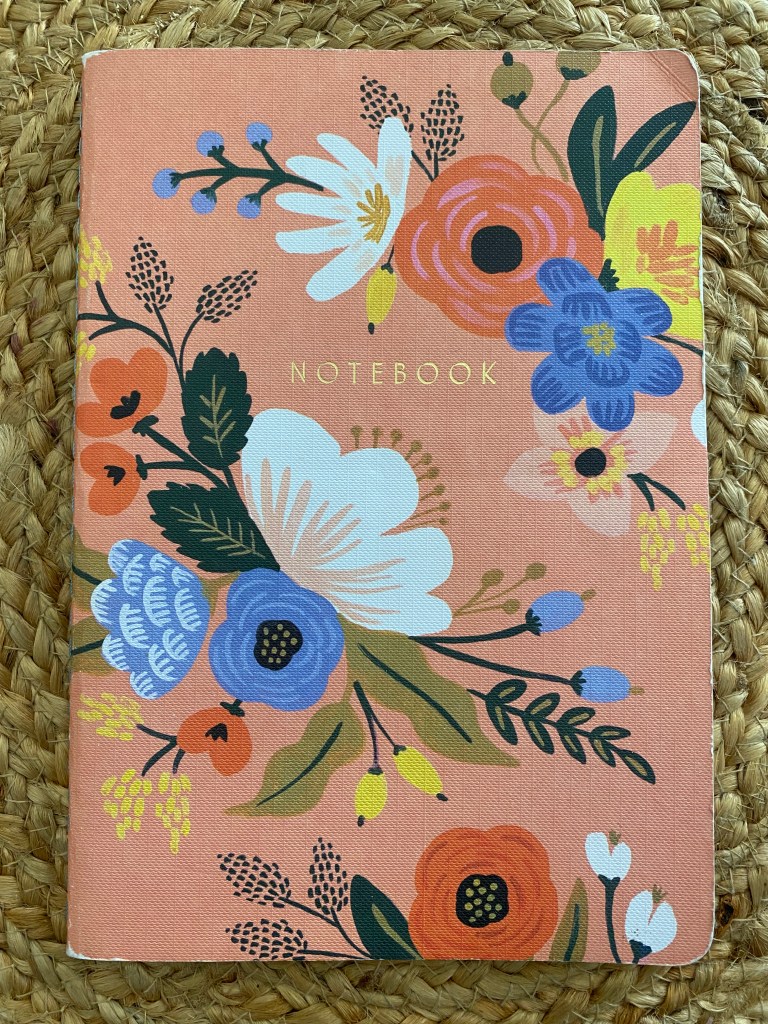
This started when I received my first diary as a 9th birthday gift from Grandma Smith. I loved that special red diary with a lock. I chuckle now to read my first entry and see how I came back with a pencil and corrected what I’d written in ink:
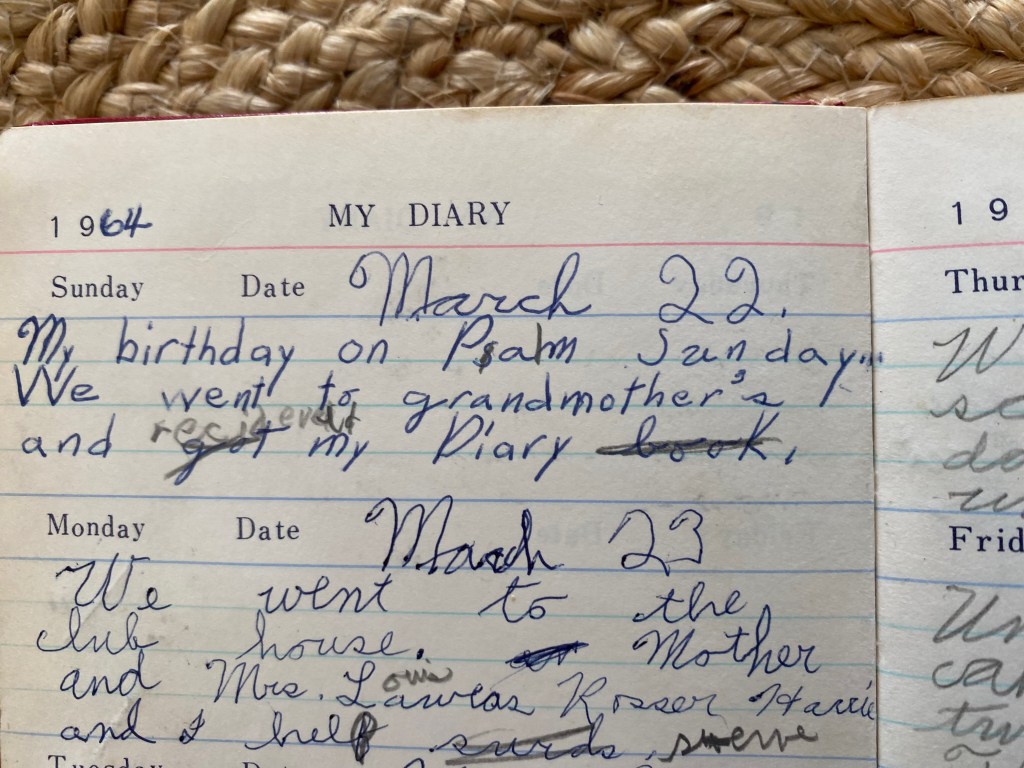
My entries throughout reflected the most important aspects of my life: my family, friendships, first days of work in tobacco, boys I liked, and favorite activities—like swimming and going to friends’ houses to spend the night. Even at a young age, going from printing to cursive, I can see my moods reflected in the size and control of my writing.
My second diary, I found in an empty drawer of a bureau when I moved into an upstairs bedroom when I was in 6th grade. We lived in the Rosser home place–where Daddy grew up. I thumbed through the diary and the only entry, February 11, 1933, surprised me; it was Daddy’s handwriting. He was just two-weeks away from his thirteenth birthday:
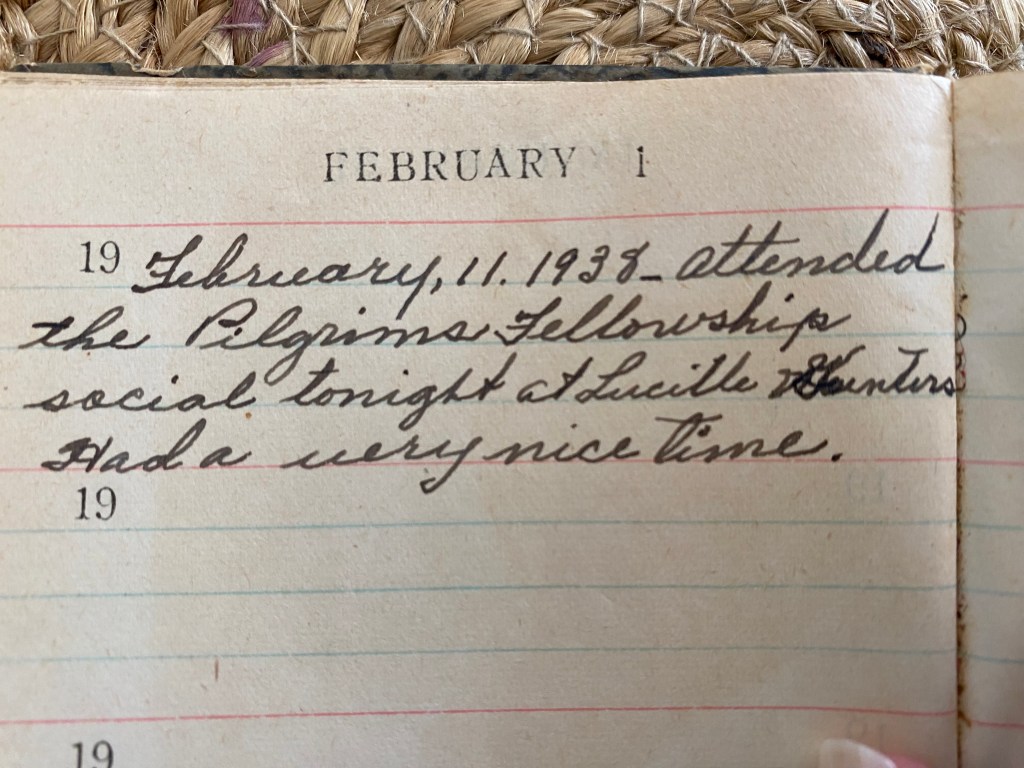
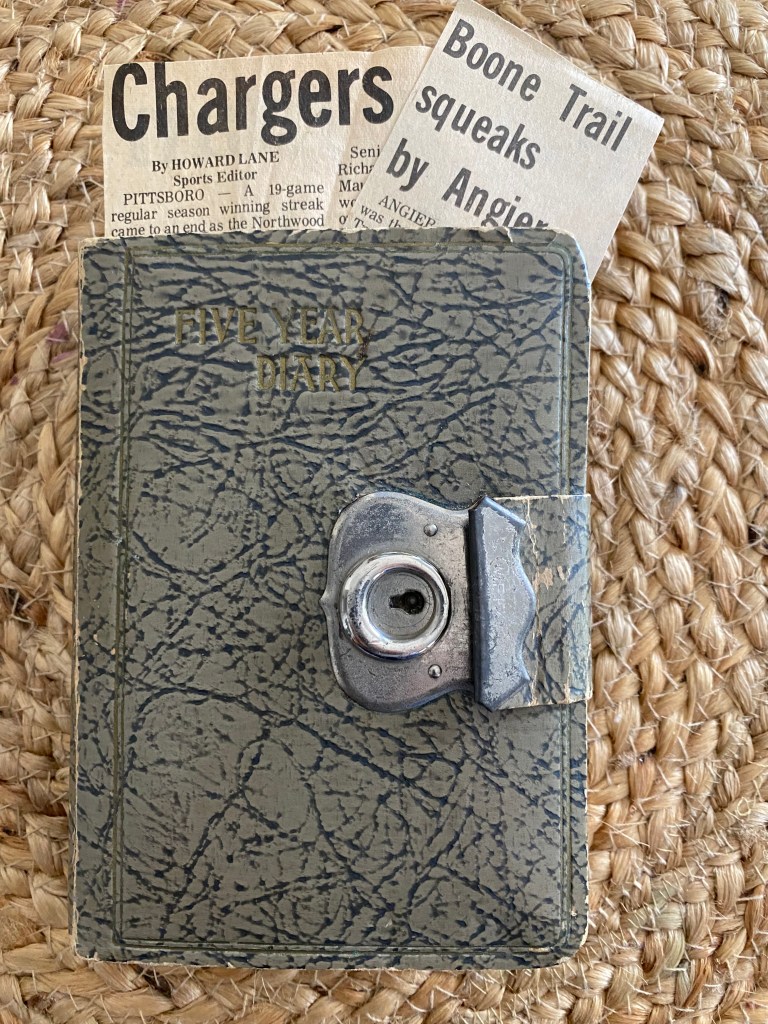
Daddy must not have taken to journal writing because that was his only entry. I took that diary and used it for my own, describing my life through middle and high school. Again, it was filled with my confusing emotions about relationships with family and friends. There were more entries about boys I liked; some I dated, others I wished I was dating! I stored newspaper clippings and small mementos between those pages of that special journal. Reading through those entries, I see the same girl that was in the red diary— just older and dealing with the same concerns. The size and control of my handwriting spoke to my mood, my point of view.
As an adult, I’ve continued to find it helpful to journal. Over the past couple of years of dating, I have some of the same up and down entries, same changes in handwriting as when I was much younger. Still, writing things out helps me to see things more clearly; it helps me to see what I’m thinking.
Last week after my session with my therapist, rather than reading my novel, I felt drawn to rereading my journal entries. My focus was on being more clear about my relationship with the man I’ve been dating since February. As I read those pages, I saw the course more clearly and understood why my therapist had challenged the validity of my thoughts. So many times when I’m alone, I take my way of thinking as truth. This happened during the COVID lockdown and during my recent illness with pneumonia– both times of isolation.
How easy it is when we’re isolated, and have no one to challenge our views, for negative, unrealistic, skewed thinking to take over. “What we think about expands” and that’s especially true in the vacuum of being alone.
Over the years of growing up in the church, I heard verses from the Bible that spoke to the importance of guarding your mind. Just a couple that came up in a quick look on the internet were Romans 12: 2 “be transformed by the renewal of your mind” and II Corinthians 10:5 “take every thought captive.” (This is just a portion of each verse and does not give context. It’s only meant to give examples for purposes of this blog post)
As a girl, I used to think these verses meant to not think about bad things, like the things you were taught not to do: hurt or hate others, break the law, think you’d rather be playing than sitting in church. But over the years, I’ve seen how what may be small things in our thinking have a huge impact on our lives. When I was a mental health nurse, I learned about how correcting cognitive distortions can help with anxiety and depression.
In remembering the value of therapy that challenges our cognitions, I looked at a couple of online sources that focused on correcting thinking. In a blog post by Kristi Schwegman, LCSW entitled, “17 Common Thinking Errors; How to Identify and Replace Them” she starts out by giving the basis of why we humans have these errors:
“”Do you believe everything you think? You shouldn’t!
Our brains are wired to make connections. This helps it to work fast and efficiently. But our brains don’t get it right every time. We have to be aware of what we’re thinking because it’s too easy for our brains to make assumptions or twist thoughts to help them fit a certain narrative that it’s created.”
She gives examples of each of these errors. I look back at my thinking and see I had blown things out of proportion. I had magnified the problems while minimizing the consistently good things in our relationship.
Another online source that was helpful was a video by Kirk Duncan, “How to Stop Doubting Your Relationship.” In that video, the instruction to look at how much you’re “managing your mind” came up again. No matter what kind of relationship–whether it’s dating, marital, friendship, parent and child, his presentation on how our minds look for evidence is helpful. https://youtu.be/7wGixJvH00s
I leave you this week, considering how what you think about expands, and hoping you will find ways to correct those thoughts that keep you from the life you desire.
Best to you,
Connie
 Connie Rosser Riddle
Very interesting especially Daddy’s one journal entry etc. I kept a diary for a few years in jr. high and high school. Great post.
Sent from my iPad
>
LikeLike
Hey Harriet,
Thanks a lot for reading and sharing your journaling experience. I loved seeing Daddy’s handwriting, and just yesterday when I wrote the post, realized he was only thirteen at the time. Thought of him in his twenties!
Thanks for your encouragement, Big Sis,
Connie
LikeLike
Connie,
Just found time to come back to this. You have started to tackle the one aspect of life that will continue to bring you to the beginning, express a thought, get distracted with that thought to take you in another direction. Then when you think you have all ideas together, you see where you have missed the point to start all over again. I can see where, if you keep a journal you have reference points that will help you keep things on track. Me, I think the spontaneous reaction keeps the confusion in line with your direction. Loved reading this and it did help me find a center to dwell on. Keep the great work going. Love and Blessing to you. John,
LikeLike
Hey John,
Thanks so much for reading and responding. Journaling does help me to get perspective–to see how things occur over a lifetime and how I respond at my various ages. Sometimes I should just let it all be spontaneous and not try to record it!!
Best to you,
Connie
LikeLiked by 1 person